Missing Pet Scams: Protect Yourself During a Pet Search

When a dog or cat goes missing, every call, text message, and reported sighting can feel urgent. Unfortunately, missing pet scams are designed to exploit that fear, urgency, and hope.
Scammers often monitor lost-pet posts on social media and community websites. They may use your pet’s name, photograph, breed, or last-known location to make a false claim sound convincing. Some demand money before providing proof, while others try to steal personal information or access your online accounts.
Knowing the warning signs can help you separate a legitimate lead from a scam without ignoring information that could help bring your pet home. This guide explains the most common scams, how to verify a reported sighting, and what to do when a message does not feel right.
Common Missing Pet Scams to Watch For
Demanding Payment Before Providing Proof
One of the most common scams begins with someone claiming to have found your pet but refusing to provide clear proof until you send money. The payment may be described as a reward, transportation charge, veterinary bill, or reimbursement for food and other care they claim to have provided.
A photograph alone is not reliable proof. Scammers can take pictures directly from your missing-pet post and use editing tools or artificial intelligence to remove the background, flip the image, slightly change the pet’s position, and place the animal into a completely different setting. The altered photograph may look convincing even though the person has never seen your pet.
Ask the person to FaceTime you or use another live video-calling service so you can see the animal in real time. If that is not possible, request a new five- to ten-second video of the pet. This simple step eliminates most scammers. A common excuse is that their camera is broken or they can't record a video.
Do not send money when someone refuses to provide reasonable visual proof. A legitimate person with your pet should understand why you need to confirm the animal is actually in their possession.
Fake Veterinary Emergency Claims
Another common scam involves someone claiming that your pet was struck by a vehicle, injured, or taken to an emergency veterinary clinic. They may say the clinic refuses to help the animal until you immediately send a deposit or reimburse the person who transported your pet.
Scammers use this type of story because they know fear and emotion can overpower rational thinking. By claiming that the pet is injured and needs immediate help, they create a high-pressure situation that gives the owner little time to stop, verify the information, or carefully consider the payment request. The urgency is intentional—the faster they can make someone react, the less likely the scam will be recognized.
Like a doctor’s office responding to an emergency, a reputable veterinary clinic will generally provide essential initial care, such as stabilization or pain management, rather than let an injured animal suffer while waiting for payment. Although payment may be required for continued testing or treatment, a demand for immediate payment before the animal receives any care should be treated as a serious warning sign.
Ask for the clinic’s full name and location, but do not call a telephone number or follow a payment link provided by the person contacting you. Look up the clinic’s official telephone number independently and call it yourself to confirm that an animal matching your pet’s description is actually there.
Never send money directly to the caller before verifying the claim. If payment is legitimately needed, arrange it directly with the confirmed veterinary clinic through its official payment process.
Verification-Code Scams
A scammer may claim that they need to verify that you are a real person or confirm that you are the pet’s owner. They will ask permission to send a code to your phone and then tell you to send that code back to them.
The code is not verifying ownership of your pet. It may allow the scammer to create or access an online account connected to your telephone number. The message containing the code will usually warn you not to share it with anyone.
Never provide a verification code sent to your phone, regardless of the explanation given. A legitimate person who found your pet does not need access to your accounts or telephone number to arrange a safe return.
How Missing Pet Scams Use Fake Facebook Pages
One of the most common scams involves newly created Facebook pages pretending to be legitimate lost-pet recovery services, especially thermal drone companies. These pages contact worried owners, promise professional help, and demand payment for services that do not exist.
Scammers steal photographs, videos, logos, search stories, and recovery images from established rescue organizations and legitimate drone operators. They repost the material as if it documents their own work. Photographs belonging to Sight Hawk Drone have been stolen and used by fraudulent pages in this way.
A fake page may be very new but already claim to have thousands of followers. Many of those followers may be purchased accounts or profiles located in other countries with no reasonable connection to the local service area. A large follower count does not prove that a business is legitimate.
Check when the page was created, whether its name has changed, and whether its followers and activity make sense for the company’s claimed location. Look for a verified page, an established website, a working telephone number, a named business owner or operator, a clear service area, and consistent contact information. The absence of page verification alone does not prove fraud, but several missing or conflicting details should be treated as serious warning signs.
Do not rely only on links or contact information sent by the suspicious page. Search for the company independently, visit its official website, and call the published telephone number to confirm that you are speaking with the real business. If a page is using another company’s photographs or identity, report it to Facebook and notify the legitimate company.
Fake Microchip Tracking Claims
Scammers may claim they can locate a missing pet by tracking or remotely activating the animal’s microchip. They may ask for the microchip number, personal information, or payment before providing the pet’s supposed location.
A microchip is not a GPS tracker. It does not contain a battery, transmit a signal, or provide the animal’s live location. It contains a unique identification number that can only be read when a compatible scanner is held close to the pet.
When a veterinarian, animal shelter, or other authorized organization scans the chip, the identification number can be used to locate the owner’s contact information through the appropriate microchip registry. This makes microchips extremely valuable for identification, but they cannot be used to follow a missing pet’s movements.
Keep your pet’s microchip registration and contact information current, but do not pay a stranger who claims they can track your pet through the chip. That technology does not exist.
Fake Satellite, GPS, and Remote-Drone Guarantees
Some scammers claim they can guarantee a missing pet's location using satellites, GPS systems, special tracking software, or a drone operated remotely from another city or state. They often promise an exact location as soon as the owner sends payment.
Satellites and GPS systems cannot track an individual pet unless the animal is wearing an active tracking device designed for that purpose. A photograph, name, microchip number, or last-known location cannot be entered into a system to reveal where the pet is currently located.
A legitimate thermal drone search requires deploying the drone and operator to the actual search area. Thermal imaging can improve the ability to locate a visible animal, but it cannot see through buildings, vehicles, sheds, patio covers, or other solid objects. The pet may also have moved beyond the area being searched.
No legitimate pet-recovery professional can guarantee locating a missing pet. Anyone promising a guaranteed locate through satellite access, GPS, or a remotely operated drone should be treated as a serious warning sign.
Pressure to Move the Conversation or Send Payment
Be cautious when someone immediately pressures you to move the conversation from the original social media platform to WhatsApp, Telegram, or another private messaging service. Scammers may do this to make their activity harder to report and separate the conversation from your original missing-pet post.
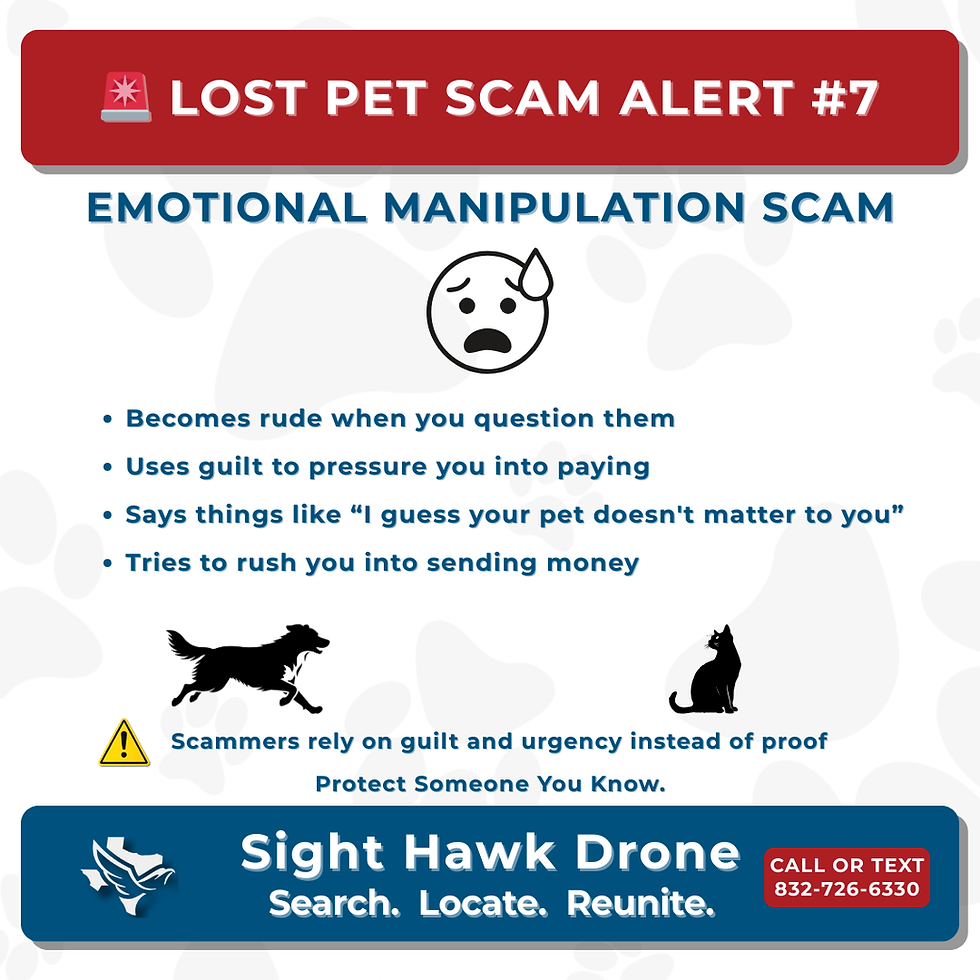
They may also demand immediate payment through a peer-to-peer payment service, gift card, cryptocurrency, or another method that may be difficult to reverse. Some become aggressive, threatening, or insulting when the owner asks for proof or refuses to pay.
Scammers may also try to shame or guilt the owner for asking questions. They may say things such as, “I guess your pet doesn’t really mean that much to you,” or suggest that a caring owner would send the money without hesitation. This language is intended to make you defend your love for your pet by acting emotionally instead of stopping to verify the claim. A legitimate finder should not insult, threaten, or pressure you for requesting reasonable proof.
Using a particular messaging platform or payment method does not automatically make someone a scammer. The warning comes from the combined behavior: refusing to speak by phone or video, avoiding reasonable questions, demanding payment before providing proof, and creating pressure to act immediately.
Keep the conversation on the original platform until the person provides credible information. Do not send money to an unverified individual simply because they claim another interested person is waiting, they are about to leave the area, or your pet will be released if you do not pay immediately.
How to Protect Yourself From Missing Pet Scams
A few simple verification steps can help protect your money, personal information, and search efforts. The goal is not to dismiss every message, but to confirm important details before treating someone’s claim as legitimate.
Keep One Identifying Detail Private
Your missing-pet post should include a clear photograph and enough information for people to recognize the animal. However, consider keeping one identifying feature private that only someone who has physically seen your pet would be likely to know. This could be a hidden marking, scar, collar detail, unusual color pattern, or another unique characteristic.
When someone claims to have your pet, ask them to describe that feature without first telling them what it is. Do not publicly post your pet’s complete microchip number or other unnecessary personal information.
A person’s inability to identify the private detail does not automatically prove they are a scammer because a legitimate witness may not have seen it. Treat the report as an unconfirmed lead until photographs, video, or additional information can support the claim.
Verify the Person or Service Before Paying
Before hiring someone to assist with your search, confirm that the person or business has a legitimate website, established contact information, a history of providing the advertised service, and reviews that appear to come from real clients.
Speak with the provider by telephone and ask how the search will be conducted, where they are located, what equipment or methods they will use, what limitations apply, how pricing works, and when payment is expected. A professional should be willing to explain the process without avoiding questions or promising a guaranteed result.
Payment policies vary between legitimate businesses, so a deposit by itself does not automatically prove that a service is fraudulent. However, do not send money to someone whose identity, location, experience, or services you cannot independently verify.
Sight Hawk Drone does not require a deposit or prepayment for a thermal drone search. Clients are billed after services have been rendered based on the actual search time used.
Confirm Sightings Before Redirecting Your Search
A false or mistaken sighting can waste valuable time, money, and search resources. It may also pull the search away from the areas where your pet is most likely to be.
Ask the person for the exact time and location of the sighting, which direction the animal was traveling, how long they observed it, and what identifying features they noticed. Ask whether they captured a photograph, video, doorbell-camera recording, or other supporting information. It is also reasonable to ask how confident they are that the animal was actually your missing pet and what makes them feel certain.
A person can be honest and still mistake a similar-looking animal for yours. Do not accuse someone of lying simply because they cannot provide proof. Record the information and treat it as an unconfirmed lead until additional sightings or evidence support redirecting your search.
What to Do If You Suspect a Missing Pet Scam
Before blocking the person, save screenshots of the complete conversation, profile, telephone number, username, payment request, payment account, and any photographs or links they sent. Keep this information in case the account disappears or the name changes.
Stop communicating if the person refuses reasonable proof, becomes threatening, or continues pressuring you to send money. Report the account and messages to the social media or messaging platform where the contact began.
If you sent money, contact your bank or payment provider immediately and report the transaction as suspected fraud. If you shared a password, verification code, or other account information, change the affected passwords, review your account-recovery information, and secure the accounts as quickly as possible.
Report threats, extortion attempts, or financial losses to the appropriate law-enforcement or fraud-reporting agency. Providing screenshots, payment records, usernames, and telephone numbers may help document the pattern and protect other pet owners.
Stay Focused on Bringing Your Pet Home
Missing pet scams succeed by turning fear, urgency, and hope against worried owners. Pausing long enough to verify a claim or payment request does not mean your pet matters any less to you. It protects your finances, personal information, and ability to continue the search.
A legitimate finder or pet-recovery professional should understand why you need proof. Ask questions, independently confirm important information, and do not allow guilt, threats, or artificial deadlines to force an immediate decision.
If your dog or cat is missing in Spring, Houston, The Woodlands, Tomball, Conroe, or the surrounding Greater Houston area, Sight Hawk Drone provides free initial phone guidance and professional thermal drone search services. Visit www.sighthawkdrone.com or contact us to request help.
Search. Locate. Reunite.
Comments